Daily Task Dashboard
The Program Stops Living In One Person's Head.
In most pharmacies the compliance packaging program belongs to the most experienced person on staff, and it runs out of a notebook, a spreadsheet, and their own memory. That works, right up until they are away.
The Daily Task Dashboard and Authorizations are one product, bought together. They are two halves of the same job, not two things to choose between.
The Day, As A List Instead Of A Memory.
The dashboard is the day. Everything that has to happen before a pack is filled is on it, in a state you can see, belonging to someone who can be anyone.
01
What is due
Patient cycles and due dates, ordered by what needs attention first. The queue answers "what am I doing today" without anyone having to reconstruct it.
02
Changes as a worklist
A dose change is a task with a state, not a note on a sticky. It is done or it is not, and the list is the one that says which.
03
Refills, before the fill
Medications out of refills surface before the pack is filled, rather than after it is sealed and someone has to open it again.
04
Pending and overdue
What is out for signature, what is late, and who it belongs to. The things that quietly slip are the things the system keeps loudest.
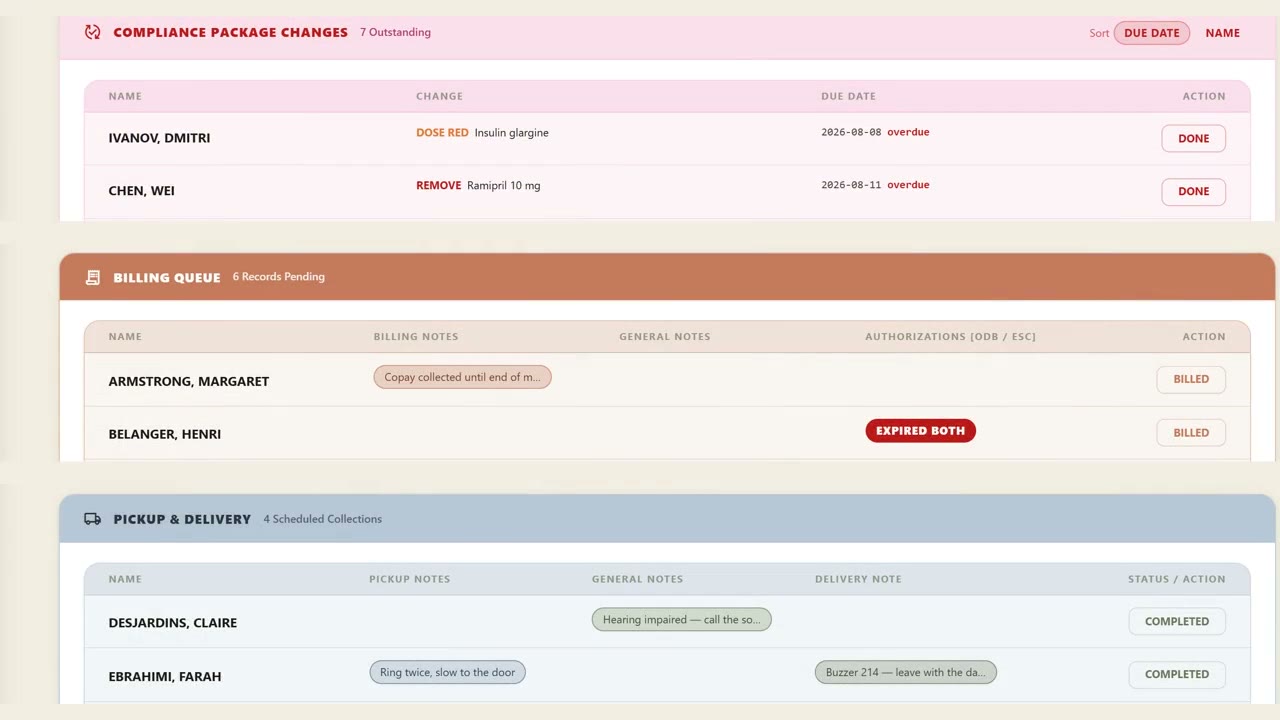
The daily queue. A real screen from a demonstration pharmacy with invented patients.
Anyone on staff can run the day.
This is the change owners tend to notice first, and it is not that the work got faster. It is that the work stopped being attached to one person. Fewer mistakes, less mess, no discrepancy between what two people think is true, and training that takes hours rather than months. A vacation, a sick day, or a resignation stops being an operational event.
One Place Where The Truth Lives.
The spreadsheet, the notebook, and the notes on somebody's phone stop being the system of record. Not because anyone bans them, but because there is finally one place that is more current than they are, and everybody is looking at it.
That is what makes the program transferable. A record that only one person can read is not a record, it is a dependency.
What It Does Not Do.
OperHand runs the program around the packs, not the packs.
It does not hold the compliance package grid, a medication profile, a dispensing record, or a maintained medication list. Those live in your dispensing system and stay there.
What it does hold is the operational program: what is due, what changed, what is waiting, and what was done. A change note naturally names the medication it concerns, because that is what makes the note useful to the person acting on it. That is an instruction, not a clinical record, and the difference is the whole design.
The Rest Of The System.
Put a week through it.
The dashboard is the part that is hard to describe and immediately obvious to use. A week of real cycles tells you more than any explanation.
Start Free TrialBack to the overview