
Authorizations
Every Authorization, Current And Accounted For.
ODB can recover money billed for a compliance package patient who does not have a current signed frequent-dispensing authorization. OperHand makes that paperwork something the system does, on a schedule, rather than something a person has to remember.
Authorizations and the Daily Task Dashboard are one product, bought together. They are two halves of the same job, not two things to choose between.
The Question Most Owners Cannot Answer Quickly.
Could you produce a current signed authorization, for every compliance package patient, covering every year you have billed?
Most pharmacies can answer that for this year without much trouble. The question gets slower the further back it goes, because the answer is not in one place. It is in a filing cabinet, a fax confirmation, someone's memory of a conversation with a prescriber, and a folder nobody has opened since the last time it mattered.
We ask this rather than assert it. What a reviewer can request, and how far back, is a question for your own advisors. What we can say is that a pharmacy which can answer it in a few seconds is in a different position from one that cannot.
What The System Does With It.
01
Generates
The authorization is produced from the patient record, filled and ready to go. No blank form to find, no details to re-key from another screen.
02
Sends, and follows
Out for signature, and tracked the whole time it is out. Pending, signed and overdue are states the system holds, not things anyone keeps in their head.
03
Files
Signed forms are archived against the patient and retrievable by name and by year. The answer to the question above becomes a search.
04
Renews on a schedule
Renewal runs whether or not anyone remembers it. That is the entire point. The paperwork stops depending on who is in today.
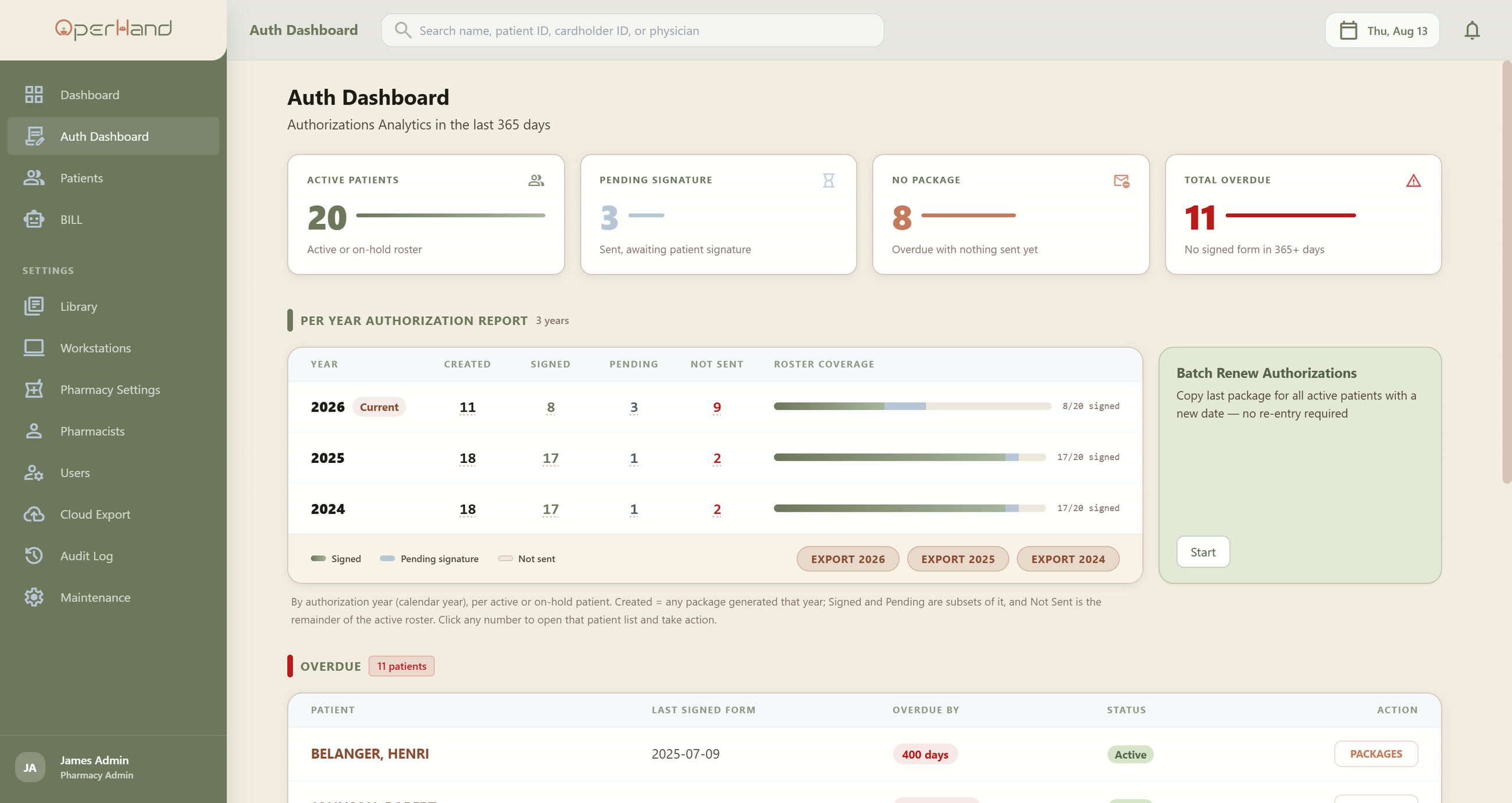
The Authorizations dashboard. A real screen from a demonstration pharmacy with invented patients.
The mismatch nobody finds until somebody goes looking.
A patient can be billed at a dispensing frequency that does not match what was actually signed. Day to day, nothing about that looks wrong, because the two facts live in two different systems and nobody holds them side by side. OperHand holds both, so it can compare them and raise a contradiction flag while it is still a correction rather than a finding.
What It Does Not Do.
OperHand runs the program around the packs, not the packs.
It does not hold the compliance package grid, a medication profile, or a dispensing record. Those live in your dispensing system and stay there. What OperHand holds is the program that surrounds them: the authorizations, the schedule, the states, and the evidence that the work was done.
This is a deliberate boundary, not a gap. Your dispensing system remains the clinical record. OperHand is the operational one.
The Rest Of The System.
See it against your own patient list.
The fastest way to answer the question at the top of this page is to watch the system answer it for you.
Start Free TrialBack to the overview